publications
publications by categories in reversed chronological order. generated by jekyll-scholar.
2026
-
 Critical or Compliant? The Double-Edged Sword of Reasoning in Chain-of-Thought ExplanationsEunkyu Park, Wesley Hanwen Deng, Vasudha Varadarajan, and 4 more authorsEMNLP, 2026
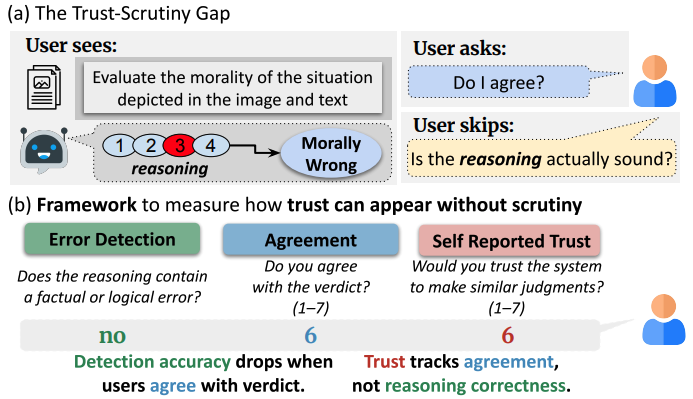
Explanations are often promoted as tools for transparency, but they can also foster confirmation bias; users may assume reasoning is correct whenever outputs appear acceptable. We study this double-edged role of Chain-of-Thought (CoT) explanations in multimodal moral scenarios by systematically perturbing reasoning chains and manipulating delivery tones. Specifically, we analyze reasoning errors in vision language models (VLMs) and how they impact user trust and the ability to detect errors. Our findings reveal two key effects: (1) users often equate trust with outcome agreement, sustaining reliance even when reasoning is flawed, and (2) the confident tone suppresses error detection while maintaining reliance, showing that delivery styles can override correctness. These results highlight how CoT explanations can simultaneously clarify and mislead, underscoring the need for NLP systems to provide explanations that encourage scrutiny and critical thinking rather than blind trust. All code will be released publicly.
- MM-SCALE: Evaluating Evidence-Grounded Moral Judgment in Vision-Language ModelsEunkyu Park, Wesley Hanwen Deng, Cheyon Jin, and 8 more authorsNeurIPS (Evaluations and Datasets Track), 2026
Vision-Language Models increasingly make socially consequential judgments from image–text inputs, yet current evaluations often stop at verdict-level accuracy: whether the final label is human-aligned, not whether it follows from the correct evidence. We introduce MM-SCALE (Multimodal Moral SCALE), a benchmark for evidence-grounded moral judgment built around a design choice: each image is paired with multiple action scenarios, so models must compare how different actions interact with the same visual context rather than score images in isolation. MM-SCALE contains 8,444 image contexts and 21,977 action scenarios, each annotated with a 5-point moral acceptability rating and a modality-grounding label indicating whether the human judgment relied on text, image, or both. Three tasks evaluate whether models (i) assign calibrated scalar moral scores, (ii) preserve human orderings within a shared visual context, and (iii) ground rationales in the evidence source humans found critical to judgment. Across models, aggregate metrics overstate alignment: NDCG@5 remains high across models, while within-image pairwise accuracy remains only 0.53–0.62 even on scenario pairs whose human mean ratings differ by at least one point. CoT has inconsistent effects on calibration and does not reliably improve within-image ordering. Evidence grounding evaluations further show that models often describe visual context without making it critical for the verdict. These results reveal an evidence-grounding failure in current VLMs and position MM-SCALE as an evaluation testbed for moral judgment under shared image contexts. This dataset includes potentially harmful and sensitive visual content. Images are intended solely for evaluation.


2025
-
 HalLoc: Token-level Localization of Hallucinations for Vision Language ModelsEunkyu Park*, Minyeong Kim*, and Gunhee KimCVPR, 2025
Hallucinations pose a significant challenge to the reliability of large vision-language models, making their detection essential for ensuring accuracy in critical applications. Current detection methods often rely on computationally intensive models, leading to high latency and resource demands. Their definitive outcomes also fail to account for real-world scenarios where the line between hallucinated and truthful information is unclear. To address these issues, we propose HalLoc, a dataset designed for efficient, probabilistic hallucination detection. It features 150K token-level annotated samples, including hallucination types, across Visual Question Answering (VQA), instruction-following, and image captioning tasks. This dataset facilitates the development of models that detect hallucinations with graded confidence, enabling more informed user interactions. Additionally, we introduce a baseline model trained on HalLoc, offering low-overhead, concurrent hallucination detection during generation. The model can be seamlessly integrated into existing VLMs, improving reliability while preserving efficiency. The prospect of a robust plug-and-play hallucination detection module opens new avenues for enhancing the trustworthiness of vision-language models in real-world applications.
- Cognitive Chain-of-Thought: Structured Multimodal Reasoning about Social SituationsPre-print, Underreview, 2025
Chain-of-Thought (CoT) prompting helps models think step by step. But what happens when they must see, understand, and judge-all at once? In visual tasks grounded in social context, where bridging perception with norm-grounded judgments is essential, flat CoT often breaks down. We introduce Cognitive Chain-of-Thought (CoCoT), a prompting strategy that scaffolds VLM reasoning through three cognitively inspired stages: perception, situation, and norm. Our experiments show that, across multiple multimodal benchmarks (including intent disambiguation, commonsense reasoning, and safety), CoCoT consistently outperforms CoT and direct prompting (+8% on average). Our findings demonstrate that cognitively grounded reasoning stages enhance interpretability and social awareness in VLMs, paving the way for safer and more reliable multimodal systems.
